

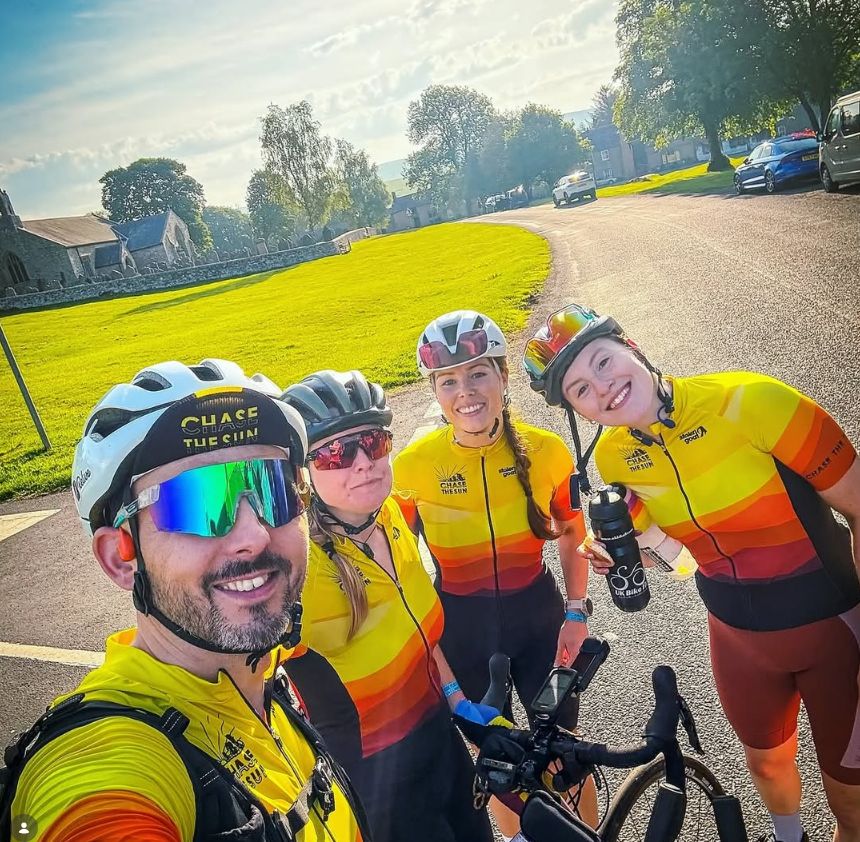

Endurance cycling is all about having the fitness and the determination to go the distance. Whether you’re inspired to take on an ultra cycling event, such as Chase the Sun (check out our race guide here). You’re interested in a multi-day bike packing tour. Or you just want to top the leaderboard in your Strava club for most kilometres racked up (join the Stolen Goat Strava Club here!). There’s something satisfying about being able to go the distance with nothing but pedal power to get you there.
But if you’re just getting into the world of endurance cycling, you might be wondering how to build up your fitness without burning out. In this article, we share some top tips on how to improve your cycling endurance with expert insights from cycling coach Josh Brandwene.
Meet the expert
Josh Brandwene, founder of Climb with Josh, is a UESCA licensed cycling coach with a degree in Kinesiology. Offering 1-1 online cycling coaching alongside coached cycling holiday, Josh currently works with athletes from 7 different countries. Josh has summitted over a dozen of the famous Pyrenean cols, so it’s safe to say he knows more than a thing on two on how to take on the big cycling climbs!
Ditch the go hard or go home mindset: The importance of Zone 2 rides for building endurance
A common mistake cyclists make when they’re trying to up their mileage is trying to ride longer, at the same intensity they’ve been holding for shorter rides. But this go hard or go home mindset is not only going to hold you back from achieving your endurance cycling potential. It also puts you at risk of burnout and injury.
“Improving your cycling endurance and being able to ride longer distances involves patience, gradual progression and adaptation,” Josh explains. When it comes to endurance riding, you’ll hear a lot about ‘building a base’ or ‘zone 2 training’. What we’re actually talking about here comes down to metabolics”
“We’re all hardwired with two types of muscle fibres: slow twitch and fast twitch. Those fast twitch fibres are the ones we call upon when we want to blast up a short, intense climb or put in a surge to sprint for the finish line. These higher intensity efforts utilise glycogen (the fuel in your body) and as a by product, they also create lactate.”
Steady state riding will turn you into a lactate clearing machine
Lactate, and specifically the hydrogen ions that it binds with, create that burn we all know far too well in our legs after a hard effort. This is where ticking off steady state rides to develop your slow twitch muscle fibres comes in, says Josh.
“Our slow twitch muscle fibres are not only vital for our long endurance efforts: they actually utilise lactate as a minor source of fuel which helps to clear lactate.”
“When it comes to going long, you need to spend the bulk of your training time working at the appropriate intensity to engage that slow twitch energy system, so that you’re training your muscle fibres to become super-efficient at clearing lactate. This is what’s going to help you to be able to ride longer distances, without burning out.” The physiological adaptations from steady state riding will help your body to become more efficient, meaning you can ride for longer before the signs of fatigue start to kick in.
When we insist on using the ‘go hard or go home’ approach (doing all of our rides and training sessions at max effort) we neglect our slow twitch muscle fibres. “For cyclists, this means you’ll be able to ride maybe an hour or so pretty fast… but then you’re going to feel exhausted. Your capacity to stay in the saddle any longer will become limited.”
It takes patience and to some extent, a bit of restraint, but putting the time and effort into training your slow twitch fibres really can be a game changer if you want to go the distance.
“Building a zone 2 base sounds quite boring,” Josh admits. “Instead, let’s think of it as training your body to become a lactate clearing machine. That sounds way more motivating!”
Want to dig deeper into the benefits of Zone 2 training? Check out our in-depth article on training zones.
Make sure your weekly training schedule balances volume, intensity and recovery
Once you start to increase your overall training volume, it’s important to really start dialling in what your overall schedule looks like. Simply adding in more training without looking at the overall load, fatigue and opportunity to recover adequately is a good way to land yourself on the injury bench.
“Every cyclist is different, and each individual’s precise training load and balance will come down to factors such as current ability, goals and time available to train,” says Josh. This is where investing in coaching can be useful. “But essentially, you want to be spending the bulk of your weekly training time working in Zone 2.”
That doesn’t mean it’s all steady, all the time though. There’s still room for a bit of spice, even in endurance cycling! “You still want to mix in a little higher intensity work to keep things fun and to make sure you’re not totally neglecting those fast twitch muscle fibres. Just because a ride is long doesn’t mean you won’t have any sharp climbs to scale along the way!”
How to combine steady state volume with some higher intensity
“Your higher intensity training could be as simple as adding in a few short ‘pick up’ intervals into your long rides to keep things interesting. Or you could bring in some threshold work, ticking off a shorter interval session (ideal for mid-week) with Zone 4 intervals where you’re going hard, but not at max effort.
The key takeaway is that your training shouldn’t be about destroying yourself, day in and day out. “Take a methodical approach,” says Josh, “learn about the science behind the training and be patient.”
“You’ll make solid gains in a reasonable amount of time. But don’t expect results in a week or two. It’s about trusting the process and committing to the long haul. Get it right and you’ll start to notice you can not only clock up bigger mileage – you also feel way better doing it!”
How to improve your speed over longer distances
Once you’ve reached the stage where you can comfortably tick off long rides and back to back days in the saddle. You might start to wonder how you can get faster over longer distances.
If you want to go further, faster, there are a few things you can do, Josh explains:
Gradually push your top end Zone 2 work
“The first thing is to start bumping your Zone 2 a little higher. Improving your Zone 2 capacity means you’ll be able to push higher power, and go faster, for the same “easy endurance” heart rate (or perceived exertion). The specific training will be individual to every cyclist, but broadly speaking, you’ll want to look at your power and your heart rate in tandem. Experiment with pushing that top end Zone 2 power (without going too hard and creeping into Zone 3). Over several sessions you’ll see that your body adapts and you’ll be able to put out higher power in Zone 2 for the same heart rate.”
Start to bring in some higher intensity interval work
It’s important that you’ve done the groundwork to have a strong base of endurance first. But once that’s in place, you can start to layer in higher intensity work in your interval sessions.
“Start bringing some VO2 max interval sessions into your training. This will help to build your strength, aerobic capacity and develop your fast twitch fibres. Eventually, that’ll translate to your Zone 2 endurance pace being that bit quicker.”
“It’s really important, though, that you spend an appropriate percentage of your training in this higher intensity zone. This is about quality, not quantity.”
“Even professional cyclists are typically only spending a maximum of 8 or 9% of their total weekly training time in those higher intensity zones. So as amateur riders, trying to do more than that is just mismanaging our training time and putting us at higher risk of fatigue, injury and burnout. Incorporating the appropriate amount of high intensity work will allow you to become faster and more efficient without getting exhausted.”
Marginal gains beyond your training
Riding faster for longer is not just about how physically fit you are. It’s also important to consider things like your gear: are you losing watts to kit or bike set ups choices that are creating unnecessary drag?
Your bike handling skills and technique can also make a difference. “Speed over longer distances really comes down to honing your riding tactics and techniques. For example, getting familiar with your own personal optimal riding cadence, being able to climb more efficiently and feel stronger on the hills without burning too many matches. Practicing your bike handling skills so you can take a better line on the corners and lose a little less time there.”
“Once you’ve got a science-based, methodical approach to training nailed it’s also going to come down to finding those marginal gains out on the roads.”
Want more training tips? Check out Josh’s insights on how to improve your climbing on the bike.